LONDON (CNNMoney) —It's really crunch time now for Greece.
This much was clear Sunday: Europe will not offer Greece the
massive bailout it urgently needs to stay in the euro unless it commits
to much deeper economic reforms and shows it can deliver them.
That
was the message from European finance officials, after they kicked off a
second day of frantic diplomacy Sunday on Greece's request for a new
rescue.
Greek Prime Minister Alexis Tsipras, arriving for talks
in Brussels with the leaders of the other 18 countries that use the
euro, said he was ready to compromise.
Whether that will be enough to get the money flowing again soon, and allow Greek banks to reopen, remains unclear.
German Chancellor Angela Merkel cautioned that Sunday's talks would be "difficult, and there won't be a deal at any price."
Europe
and the International Monetary Fund estimate Greece needs between 72
billion and 74 billion euros ($82 billion) over the next three years.
They have already lent Greece about 233 billion euros since 2010.
Several
officials made clear that the Greek government needed to go beyond a
reform proposal it submitted last week, and commit to more changes to
pensions, taxes and other areas. And it needs to provide proof those
measures will happen.
"We've come a long way but big issues still
are open, so we're going to put those to the government leaders and it's
up to them," said Jeroen Dijsselbloem, who chaired the meeting of
finance officials.
Finland's finance minster, Alex Stubb, said
Greece was being asked to pass into law a series of far-reaching
conditions by July 15.
Trust in Greece's commitment to reform was
shattered by January's election of a prime minister fiercely opposed to
austerity, and a series of government U-turns in the last two weeks --
including calling a referendum to reject reforms it then signed up to
days later.
The weekend of meetings follows an ultimatum Europe
gave Tsipras earlier this week: Show us you're serious about putting
Greek finances in order, or you're out of the eurozone.
A separate meeting of the leaders of the 28-nation European Union scheduled for Sunday was canceled.
Without
agreement in principle to start talks on a bailout, the crisis in
Greece will only deepen, dragging the country ever closer to exit from
the euro.
Its banks have been shut for two weeks, and cash
withdrawals are capped. The vital tourism industry is suffering. People
are spending less, some public services have stopped charging, and the
healthcare system is running out of imported medicines.
Greece
needs to pay pensions and wages this week, and make a big debt repayment
to the European Central Bank next week. Without an injection of funds
fast, it may have to issue IOUs, a first step to printing its own
currency.
The package of reforms Greece proposed included
spending cuts, tax hikes, and plans to phase out tax discounts on some
islands, among many other things. Greece also plans changes to public
pensions, such as raising the retirement age, and steps to improve tax
collection.
They're very similar to ideas put forward by the
country's creditors in late June before Tsipras walked out of talks,
triggering the collapse of the last bailout and forcing the closure of
the banks.
Assuming Greece accepts a broader overhaul of the
economy, there are still other potential roadblocks standing in the way
of a third bailout.
Opinion in some other countries that use the
euro, including Germany and Finland, is running high against another
rescue. Taxpayers don't want to put more public money at risk. A new
bailout would need to be ratified by parliament in Germany, and a
handful of other countries.
And Greece wants creditors to
restructure its debt. Europe could give it even more time to pay back
loans, and cut already very low rates of interest, but that may not be
enough. Some eurozone countries insist they can't go further and cancel
Greek debt outright.
That in turn could kill a deal. Some
eurozone countries say they'll only back a third bailout if the IMF
takes part. The IMF has made clear that it will only participate if the
Europeans agree to restructure Greece's debt.
http://www.wtae.com/money/greece-bailout-deal-still-far-away/34119246
 US Global Investors
 US Global Investors
 US Global Investors


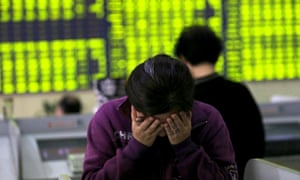 An investor covers their face with a stock exchange hall in Nantong,
Jiangsu Province, China, during the recent week of turbulence.
Photograph: ChinaFotoPress/Getty Images


